-

Gathering ricotta cheese out of the couldron. - Špela Ledinek Lozej
-

The Duplje alp, where ricotta cheese is produced by Miran Prezelj - Špela Ledinek Lozej
-

Ricotta - Špela Ledinek Lozej
-

Straining of ricotta - Špela Ledinek Lozej
-

Ricotta - Špela Ledinek Lozej
-

A housewife from the village Volarje pours boiling water over the ricotta - Jasna Fakin Bajec
-

A housewife slowly mixes the ricotta and water - Jasna Fakin Bajec
-

Ricotta soup with the corn flour - Jasna Fakin Bajec
-

Ricotta soup with the corn flour - Jasna Fakin Bajec
-

The ricotta soup can be upgraded with the corn flour as well - Jasna Fakin Bajec
-

When the corn flour is made, three spoons of ripe ricotta are put in the dish - Jasna Fakin Bajec
-

The Ricotta Soup - Miha Peče
-
2011


2015

2017


2018


2019


Ricotta soup
(Skutna župa - Skutnca - Skutni krop)
Ricotta soup (skutn’ca, skutni krop, skutna župa) is a very strong soup known across the villages of the Upper Soča Valley. In the past, housewives prepared it almost every day as a light morning meal or as dinner. Its contemporary preparation depends on the family's preferences. Since it has a strong, acrid, pungent taste, it's not nowadays a typical component of daily meals. Consequently, some cooks have modified the recipe, adding novel ingredients (e.g. vegetables) to adopt the flavour to the contemporary consumer. It's eaten more frequently by the elderly or as a sturdy helper during minor illness. Due to the fermented ricotta's nutritional value and other traits, people eat it to boost their immune system, recover from sickness (flu, pneumonia, digestion problems etc.), to boost their appetite or support their body during heavy farm work. Accordingly, preparation is simple and quick, making ricotta soup a solid choice for a quick lunch or dinner.
Recipes for its preparation differ from village to village. The essential ingredient is the salty and ripe (matured, fermented) ricotta, prepared from cow's or sheep's whey, and some boiling water. Ricotta (albumin cheese) is a speciality from the Upper Soča Valley. It is prepared from the whey left over after the process of cheese-making. Some raw milk and souring agent are then put in this primary whey, which is warmed almost to boiling, separating from the whey flakes that constitute ricotta. With sheep milk, no souring agent is added. Ricotta is wrapped in cloth and suspended so that the secondary whey leaks out. Since fresh ricotta does not keep well, it is conserved with salt. Ricotta made from cow's whey is typical in areas around Tolmin and Kobarid, while ricotta made from sheep's whey is more characteristic in areas around Bovec and Soča.
Julija Kanalec, a housewife from the village Volarje (near Tolmin) and member of the Cultural association of Rural Women from the Upper Soča Valley, presented the following cooking practice: put three spoons of ricotta (made from cow's whey) in a small bowl, and then gradually pour over boiling water while slowly mixing. The texture should be smooth rather than thick. A fresh egg may be whisked in as well, making the soup even sturdier. She serves the soup with dry (or toasted) bread, which may be crumbled inside for a high-nutrition broth. Lado Bradaškja, oldest chef in a traditional restaurant in Trenta (village in the Municipality of Bovec) knows two variations of Ricotta soup. One variation is quite similar to the above. Boil the water, and then add two-three spoons of salted ricotta (from sheep's whey in this case), stirring at low temperature then pouring into a cup. This variation is called skutn'ca or skutni krop. Another variation (called skutna župa) is prepared with the addition of corn flour. Water is boiled, corn flour mixed in to a point where the mixture is still liquid, and finally three spoons of ripe ricotta are added to the dish. Everything is mixed and pour into the cup.
Some modern housewives prepare it with potatoes, or dilute the ripe ricotta with water or milk before using it. In some villages (Livek for example) the ricotta is greased up with butter to improve the taste, making it less savoury. Some cooks use ricotta ripened only for one or two months. One of the modified recipes, presented in the booklet Dishes from the Soča Valley, includes not only salty and ripe Ricotta but also sweet, fresh one.
Skutn'ca or Ricotta soup can be used as one of the component ingredients in other dishes as well. Many times it is used for the preparation of a podlita plenta (watered polenta), an essential dish in the heavily labour-intensive days of Tolmin and Kobarid's farms. After the polenta is cooked (it should be prepared as a thin cornmeal), it is put in a bowl and poured over with ricotta soup (some people use hot milk instead), then larded up with cracklings. Traditionally, such a dish was offered to labourers (foresters, haymakers, ploughmen etc.) who assisted householders in heavy-duty farm work.
The piquant and pungent taste of the matured Ricotta is developed through the ripening or fermentation process. The initial taste of the ricotta is milder and gentler. As soon as the Ricotta is prepared from the whey, it is put in a linen bundle so that all the whey may leak out (one or two days). It is then put in special perforated wooden containers. In Trenta, where sheep Ricotta is made, the farmers sprinkle it with salt soon after putting in the wooden storage, where the mass is then stirred once or twice a day for at least one month, which is how the Ricotta subsides. In Volarje near Tolmin, the salting process is done after one month, when the Ricotta is transported from pasture to homes. It is first salted and blended for two to three days, after which it is stored. In some families the ripening process continues in a wooden container (called deže in the Tolmin area). Layers are put inside a wooden container, which is then closed with a wooden lid and weighted with a large stone. Finally, some water is added. As needed, the container is opened and the upper layer removed. This way unfortunately, much goes to waste during each opening session. The process of ripening is thus now more frequently done in glasses. Before the glasses are closed, the ricotta is smeared with fat or alcohol. Like that, the Ricotta can be stored for one or more, even up to three years. The lumpy structure with curds gradually becomes creamy and spreadable, while the aroma of ricotta acquires a full-bodied quality. The taste becomes slightly more piquant but retains its characteristic freshness. The longer the Ricotta ripens, the stronger its taste. Through the years, it changes in colour, becoming darker.
Since ripe Ricotta has an unusual flavour for the contemporary palate, the members of the Cultural Association of Rural Women from the Upper Soča Valley, which maintains an important role in the safeguarding and transmission of old recipes to younger generations in the Upper Soča Valley, do not believe Ricotta soup makes for a suitable item for markets, festivals or other region events. They prefer to prepare the better adapted and more widely known traditional dishes, which also appeal to younger generations (e.g. dumplings, nut roll, frika etc.). Besides, the chef from Trenta highlighted that it is very hard to get enough salty Ricotta from the local farmers, since they prefer to sell their Ricotta fresh. For ripening, sheep Ricotta is used, made in September and October. According to interviews, tourists don't like it very much due to its pungent taste. However, Valter Kramar from a famous restaurant in Staro Selo near Kobarid, known worldwide for top-level cuisine, frequently offers ripe Ricotta (fermented ricotta) on its menus, incorporated into serious dishes rather than served alone. They also use different herbs to alleviate the potency of the aroma. In another, smaller restaurant in the centre of Kobarid, Ricotta soup is offered with polenta (so called podlita plenta). Certain other restaurants around Tolmin and Kobarid sell it as well, but it is not an exceedingly popular specialty.
HISTORICAL-ANALYTICAL NOTES
Marija Rutar (1903–1979), well-known historian and ethnologist from the Tolmin area who also researched the culinary habits of Tolmin's people, highlighted that the Tolmin area is truly geographically diverse. It encompasses high mountain landscapes, narrow valleys and lower plateaus alike. Due to landscape diversity, culinary habits also differ from village to village. However, the Tolmin area was a poor area and people had to be very ambitious, hardworking, stubborn, inventive, efficient and incredibly modest to survive. The food was plain and simple especially in the period before WW1, when people simply ate whatever they produced in their fields or from their domestic animal husbandry. The same situation was also evident in areas around Kobarid and Bovec.
The Ricotta soup is not frequently mentioned in historical literature dealing with the culinary habits of Slovenia. Gorazd Makarovič, who did a survey on the Slovenian diet in the 19th century, merely listed that ricotta soup was a typical soup in the Tolmin area, while Marija Rutar highlighted that ricotta soup was eaten by the poor. More information on its preparation can be found in the culinary book Jedi na Kobariškem (Diets from the Kobarid Area) (villages Breginj, Drežnica, Kobarid, Livek and Smast), where different varieties of its preparation are outlined. Differences are not major, lying more or less in the process of preparation.
According to literature and story-telling, the basic recipe was never prepared for lunch but most often eaten as a morning snack (around eight or nine o'clock in the morning) to fortify the body for heavy farm labour. Quite often it was used as a home remedy for problems with the stomach, digestion as well as for physical fortitude and immune system improvement. People who suffered from asthma enjoyed it to alleviate cough. A lunch version was prepared as a thick broth by mixing in additional ingredients (potatoes, corn flour, crackling). In Kobarid, the soup was enriched by boiled and mashed potatoes, put in the soup at the outset of cooking. In Breginj and Staro Selo near Kobarid, the soup was offered with polenta. In Breginj they also offered it with cold sliced potatoes or kitchen-range grilled potatoes. In Drežnica, people added beans as well. In Trenta and Soča, it was eaten together with polenta and frika. Overall, Ricotta soup was more frequently cooked in winter.
According to the interviews, Ricotta soup was more widespread in villages with local cooperative dairies. An employed dairyman gathered milk from the village's farms and converted it to cheese and ricotta. The secondary leftover whey was an important by-product as well, used for pig fodder. At the end of the month, each family got a certain quantity of cheeses and fresh (sweet ricotta) depending on the amount of milk they brought to the dairy throughout the month.
Although the preparation of Ricotta soup was typical in every household in the Upper Soča Valley, local people did not give it special attention. It was generally not eaten as a holiday or festive dish.
LEARNING AND TRANSMISSION
The Cultural association of Rural Women from the Upper Soča Valley promotes trans-generational cooperation. In recent years, increasing numbers of young women are deciding to take a more active role in the safeguarding of local tradition. Among other factors, this is the result of the overall tourism development of the Upper Soča Valley and tourists with high expectations, who wish to discover traditional local delicacies, wholesome offer and foods. The association thus focuses on the organization of various culinary workshops, where members learn how to prepare traditional foods in modern and innovative ways. Moreover, the members are each year involved in the organisation of a local festival in Tolmin – the Tolmin Agricultural Fair, which presents not only traditional foods but also other material heritage. Visitors come from across the entire Tolmin area, including primary schools and children who appear to be quite curious about the traditional ways of life (old farms items, homemade products, old cheesemaking equipment etc.). According to interviews, the best-known local culinary festival in the Upper Soča Valley, presenting to tourists and locals the region's cuisine, is the festival Jestival in Kobarid, organised at the end of October. The organiser strives to gather a variety of local offer as well as different generations in order to promote, raise awareness on and present typical dishes from the Upper Soča Valley (e.g. frika, different types of cheeses, ricotta, Kobariški dumplings, indigenous marble trout etc.). Besides, the Soča Valley Development Centre from Tolmin (Posoški razvojni center), alongside various associations (Association of Self-Sufficiency from Kobarid; Association From Sheep to Shelf from Bovec) publishes a number of booklets with old recipes, which are upgraded and modified to suit contemporary tastes and needs.
COMMUNITY
In the Tolmin area, the Kulturno društvo podeželskih žena Gornjega Posočja (Cultural association of Rural Women from the Upper Soča Valley) is an important association that researches, presents, safeguards and develops culinary traditions. The group was established in 1976. It works under the jurisdiction of the Institute of Agriculture and Forestry Nova Gorica, dislocated unit Tolmin. Its members are from Tolmin and surrounding villages, divided by sections: section for culinary arts, artisanal manufacture, picking herbs, and choir. At the moment, it has some 125 members, with increasing inscription of younger population segment women (from 20 years on). Members of the culinary section meet once per month. They hold various lectures, organise study tours in different places to see good case studies, prepare different culinary and other workshops. The main purpose of the association was to safeguard the ethnographic characteristic of the rural areas in the Upper Soča Valley, but today their work is wider. Their safeguarding efforts are increasingly appreciated by the locals, who invite them to many local festival events (like the agricultural event in Tolmin), where local and traditional food is offered (budle, volarski štruklji, frika). Besides the housewives of Tolmin, one should mention also the Soča Valley Development Centre (Posoški razvojni center) from Tolmin, which through implementing different development and economical projects strives to research, safeguard, raise awareness and promote the sustainable development of local culinary tradition. In various projects they published many culinary booklets to show people their specialities and how to upgrade them in innovative ways. The centre also organised different study circles aimed at researching, safeguarding and presenting the typical culinary offer of the Soča valley. Some employees are also members of different local associations (e.g. Association of Self-Sufficiency from Kobarid; Association "From Sheep to Shelf" from Bovec) and together, they organise different local culinary competitions.
PROMOTIONAL ACTIONS
There are currently no safeguarding, awareness-raising or enhancement measures to promote, protect or disseminate the knowledge of ripening ricotta, which is the main ingredient of skutnca. Although the Soča Valley Development Centre (Posoški razvojni center) – established cheese tourist routes along the mountain pastures in the Tolmin and Bovec area in 2017, visitors can only buy the cheese and whey, rather than tasting secondary products (e.g. ricotta soup). One reason is administration problems, since the pastures are not registered as restaurants or tourist farms.
PROTECTIVE MEASURES
No existing measures are in place protecting ripe and salt ricotta or the product it's prepared with.
Related Intangible Heritage
Alpine dairying
Alpine dairying
Making Tolminc cheese
Preparing maslovnik
Preparing maslovnik
Preparing Mohant cheese
To learn more
Web Sites
Bibliography
Jedi na Kobariškem. Kar je bujš, je pa bujš.
Kmečki glas 2008
Jedi iz sirotke in skute: Knjižica receptov.
Posoški razvojni center 2011
Kmetijski veterinarski zavod, Kmetijska svetovalna 1996
Slovenski etnograf - Prehrana v 19. stoletju na Slovenskem
Tolminska je pesem
Tolminski muzej 2000
Jedi iz Zgornjega Posočja: knjižica receptov
Občina Kobarid 2013
Produced by
Research Centre of the Slovenian Academy of Sciences and Arts - Institute of Slovenian Ethnology - Miha Peče
Scientific Advisor
Jasna Fakin Bajec, PhD.
Release Date
11-JAN-2019 (Miha Peče )
Last update
24-SEP-2019 (Agostina Lavagnino)
Tweet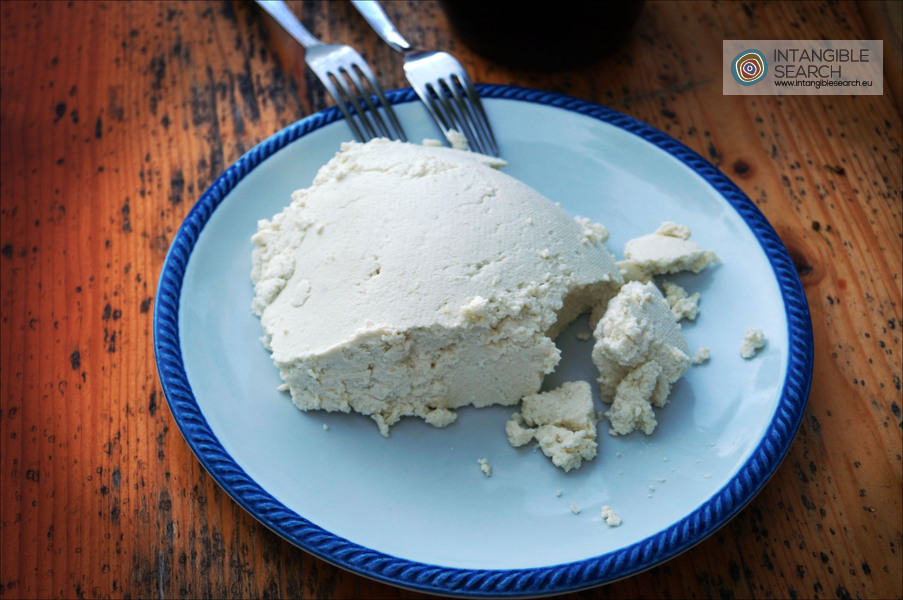
From Community
Tell us about it